

Is Kava Still Legal in 2026? A State-by-State Reality Check

Last spring we wrote about New York’s move against traditional kava drinks, and the question we got most after that post was a simple one: am I next? Customers asked it. Kava bar owners we supply asked it. A few of our own family members asked it.
So we spent the start of this year doing what we do before we buy a single kilo of root: checking the paperwork. We read the regulations, the court filings, and the state health memos instead of the headlines. What we found is more reassuring than the internet would have you believe, and also more complicated. Here is where things actually stand in 2026.
The short version
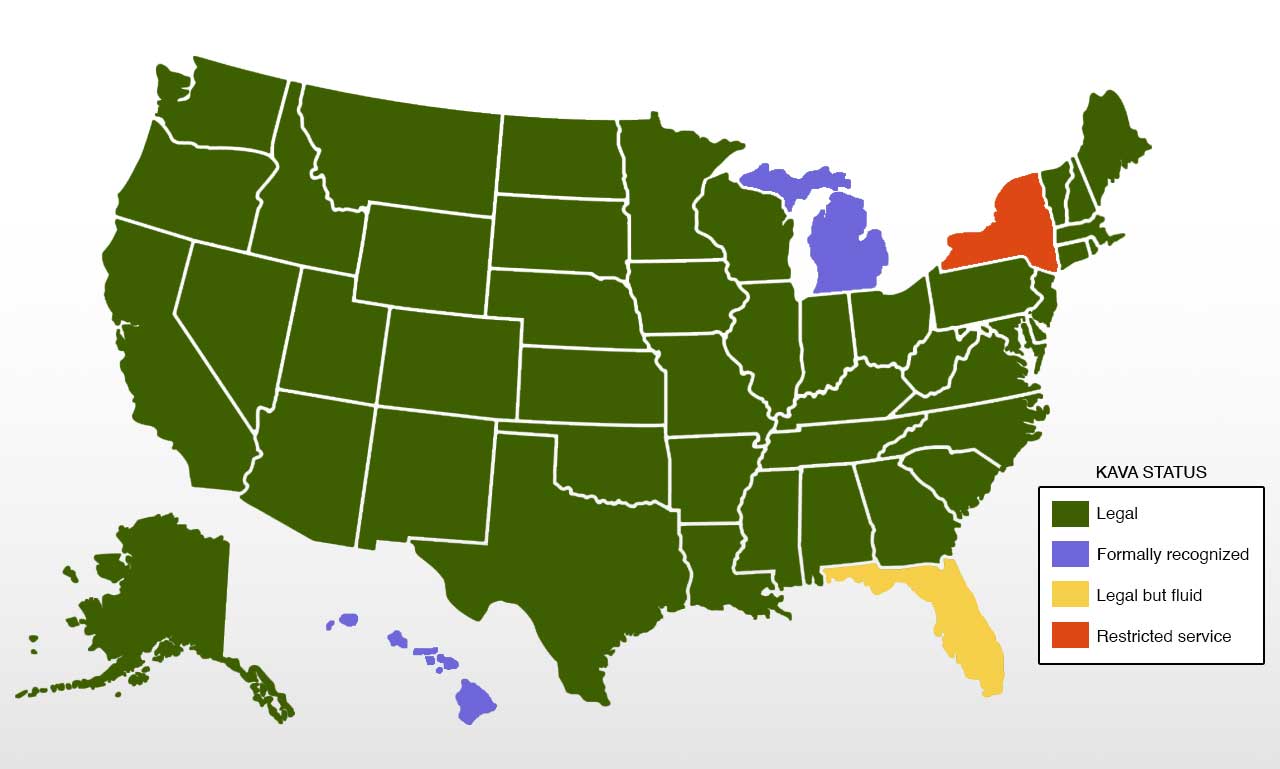
Kava is legal to buy, possess, and drink in all fifty states. It is not a controlled substance at the federal level, and the DEA confirmed as much again in its 2026 drug information sheet on the plant. There is no nationwide ban, and there is no state where simply having kava in your kitchen is against the law.
That is the headline most articles bury. Now for the parts that take longer to explain.
New York: the one real fight
New York is the only place where kava itself, rather than kratom, ran into a specific government restriction, and it is worth understanding precisely what happened because most coverage gets it wrong.
In March 2025, the New York State Department of Health issued a regulation treating traditional kava beverages sold in food establishments as an unapproved food additive. The reasoning traces back to a 2020 FDA memo that declined to recognize kava as generally safe for use as a food ingredient. Kava bars across the state, including Sacred Root in Ithaca, were told to stop serving and complied by the end of that year.
Then it went to court. The owners of Kavasutra, a tiki-themed kava cafe, argued that kava steeped in water is a single-ingredient food and should be presumed safe. In August 2025, U.S. District Judge Valerie Caproni disagreed and upheld New York City’s enforcement. Her reasoning was technical: water is itself a food under federal law, so adding kava to it, in her reading, made the kava an additive subject to tighter scrutiny.
Here is the part to hold onto. The ruling did not ban kava in New York. It did not touch kava powder, capsules, or the root you brew at home. What it restricted was the sale of prepared kava drinks inside licensed food establishments in New York City. You can still buy kava in New York. A cafe just cannot legally serve it to you in a shell across the counter. That is a real blow to the bar model, and we do not want to minimize it, but it is a narrow ruling and not the sweeping prohibition that “New York bans kava” suggests.
The bans you are reading about are mostly kratom
This is the single most common mistake we see, and it is worth slowing down for.
Search “states that ban kava” and you will get lists naming Wisconsin, Alabama, Arkansas, Indiana, Rhode Island, and Vermont. Those are kratom bans. Those states classify kratom’s alkaloids, mitragynine and 7-hydroxymitragynine, as controlled substances. They say nothing about Piper methysticum. Kava and kratom get sold under the same roofs and talked about in the same breath, so the lists bleed together, and a kratom prohibition gets recopied year after year as a kava one.
We have seen this firsthand. Wisconsin in particular gets cited as the strictest “kava” state on the internet, when the state’s actual rules are aimed at kratom. If you run a business and you are making decisions off one of these recycled lists, you can talk yourself out of a perfectly legal market.
A note on how we vetted this: while researching, we found a site claiming a Florida statute set a 30 milligram kavalactone limit per serving and required a state “Kava Compliance” seal. We could not find that law anywhere in the actual Florida code, and the statute number it cited governs disorderly conduct. We left it out. If a regulation cannot be traced to the primary source, it does not belong in your compliance plan.
The kratom crossfire is the thing to actually watch
The genuine risk to kava bars in 2026 is not a kava ban. It is getting swept up in the crackdown on kratom and especially on 7-OH, the concentrated kratom compound that regulators have been moving against fast.
Florida is the clearest example, and it matters because Florida is the capital of American kava culture with well over a hundred bars. In August 2025, the state issued an emergency rule classifying 7-OH as a Schedule I controlled substance, and the agriculture commissioner’s office reported pulling more than 17,000 packages of 7-OH products off store shelves. Then came House Bill 1205 and its Senate companion SB 994, which as written would have tightened the state’s Kratom Consumer Protection Act and barred the mixing of kratom with other psychoactive substances. That is the kind of rule that would force the many bars selling kratom-and-kava blends to rework their menus.
Both bills stalled this spring. SB 994 died in the Senate Commerce and Tourism Committee on March 13, 2026, and the House measure went nowhere without it. But a stall is a reprieve, not a resolution. The 7-OH crackdown is still moving through emergency rules and local ordinances, and the appetite in Tallahassee to wall kratom off from the products it gets mixed with has not gone away. None of this bans kava. All of it reshapes the bars that serve kava alongside kratom, and the pressure will almost certainly be back next session.
What is interesting is that some kava bar owners welcome parts of this. More than one has told reporters that the rush into cheap, highly concentrated 7-OH products gave the whole kava and kratom community a bad name, and that clearing those products out is not the worst thing for a business built on the traditional root drink. We tend to agree. The kava side of the counter has always had the stronger story to tell.
The quiet good news
While the bans got the attention, kava also had a genuinely good year in places people are not watching.
Hawaii’s Department of Health, working with the University of Hawaii, issued a Generally Recognized As Safe determination for ‘awa, the Hawaiian name for kava. That is a state government formally recognizing the long history of safe traditional consumption, and it directly pushes back on the 2020 FDA memo that the New York regulation leaned on. Michigan has reportedly reviewed the same evidence.
In December 2025, kava industry and cultural advocates publicized correspondence in which the FDA acknowledged, in written responses, that kava mixed with water as a single-ingredient conventional food would generally not be treated as a food additive when consumed as a tea. We want to be careful here, because this got reported on PR wires as “FDA officially confirms kava is a food,” and that overstates it. This is the agency answering case-specific questions, not a new rule or formal guidance. But it is meaningful, and it sits in direct tension with the logic the New York court used. The legal question of how to classify a bowl of kava is, genuinely, still being worked out.
2026 legal status at a glance
| Where | Status | What it means for your business |
|---|---|---|
| Federal (DEA and FDA) | Legal | Kava is not a controlled substance and there is no national ban. The FDA still holds its conservative position that kava is not generally recognized as safe as a mass-market food additive, but raw root, powder, and dietary supplements are sold openly nationwide. |
| New York State | Restricted service | Raw root, powder, and home brewing are fully legal. Licensed food establishments are restricted from serving prepared kava drinks over the counter, following the 2025 state regulation and the August 2025 federal ruling. |
| Florida | Legal but fluid | Kava is legal, and the state leads the country in kava bars. The regulatory heat is aimed at kratom and 7-OH, not kava. The 2026 bills that would have separated the two products in bars stalled in committee, but the pressure is expected to return. |
| Hawaii (and Michigan) | Formally recognized | Hawaii issued a state-level GRAS determination recognizing traditional, water-extracted kava as safe, with Michigan reported to have followed. That gives local vendors a strong position to point to. |
What this means if you drink kava or run a bar
If you drink kava, nothing has changed for you. You can order it, brew it, and enjoy it anywhere in the country.
If you run a bar or are thinking about opening one, the lesson of 2026 is to know the difference between the two plants on your menu and to track regulation at the state and local level rather than trusting a national “banned states” list. The kava side is on solid legal ground. The exposure comes from kratom and 7-OH, and from the food-additive question that New York raised and that the rest of the country is still sorting out.
We have been importing kava into the United States for seventeen years, through the 2002 liver scare, the kava bar boom, and now this. The plant keeps proving its history. We will keep watching the paperwork and update this post as the law moves.
Bula.
Disclaimer: We are not attorneys, and this article is general information rather than legal advice. Laws change and vary by city and county. Confirm the current rules with your state and local authorities or a qualified attorney before making business decisions. We are also not medical professionals and do not market kava as a treatment or cure for any condition.